Backport #38406 by @bircni

Addresses a batch of privately reported security issues, grouped by
area:

- **SSRF** - migration PR-patch/asset fetches, OAuth2 avatar & OpenID
discovery, pull-mirror URL re-validation, and the outbound proxy path.
- **Access-token scope** - prevent scope escalation on token creation;
keep public-only tokens confined (feeds, packages, Actions listings,
star/watch lists, limited/private owners).
- **Access control / disclosure** - go-get default-branch leak, webhook
authorization-header leak, watch clearing on private transitions,
label/attachment scoping.
- **Denial of service** - input bounds for npm dist-tags, Debian control
files, Arch file lists, and SSH keys.

### 📌 Attention for site admins

Not breaking - existing configs keep working - but two changes are worth
a look:

- **New SSRF protection** Outbound requests (migrations, OAuth2 avatars,
OpenID discovery, pull mirrors, proxy path) are now validated against
the allow/block host lists. If your instance legitimately reaches
internal hosts, you may need to add them to
`[security].ALLOWED_HOST_LIST` (and the relevant `ALLOW_LOCALNETWORKS`
settings).
- **Deprecation** `[webhook].ALLOWED_HOST_LIST` is deprecated and will
be removed in a future release. Use `[security].ALLOWED_HOST_LIST`
instead; the old key still works for now.

Co-authored-by: bircni <bircni@icloud.com>
Co-authored-by: TheFox0x7 <thefox0x7@gmail.com>
Co-authored-by: techknowlogick <techknowlogick@gitea.io>
Co-authored-by: Lunny Xiao <xiaolunwen@gmail.com>
Co-authored-by: wxiaoguang <wxiaoguang@gmail.com>
Co-authored-by: Zettat123 <zettat123@gmail.com>
Bind OAuth token introspection responses to the authenticated client.
Return an inactive response when the token grant belongs to a different
OAuth application to avoid leaking token metadata across clients.

Add integration coverage for cross-client introspection attempts against
both access tokens and refresh tokens.

Assisted-by: GPT-5.4
- set OAuth2 authorization code `ValidUntil` on creation and add expiry
checks during exchange
- return a specific error when codes are invalidated twice to prevent
concurrent reuse
- add unit tests covering validity timestamps, expiration, and double
invalidation

---
Generate by a coding agent with Codex 5.2

---------

Signed-off-by: Lunny Xiao <xiaolunwen@gmail.com>
Co-authored-by: Copilot <175728472+Copilot@users.noreply.github.com>
1. Make "Issuer" strictly follow the spec (see comment)
2. Make "/.well-known/openid-configuration" respond 404 if the OAuth2
provider is not enabled.

Then by the way, remove the JSEscape template helper because it is not
needed any more.
Resolve#31609
This PR was initiated following my personal research to find the
lightest possible Single Sign-On solution for self-hosted setups. The
existing solutions often seemed too enterprise-oriented, involving many
moving parts and services, demanding significant resources while
promising planetary-scale capabilities. Others were adequate in
supporting basic OAuth2 flows but lacked proper user management
features, such as a change password UI.
Gitea hits the sweet spot for me, provided it supports more granular
access permissions for resources under users who accept the OAuth2
application.
This PR aims to introduce granularity in handling user resources as
nonintrusively and simply as possible. It allows third parties to inform
users about their intent to not ask for the full access and instead
request a specific, reduced scope. If the provided scopes are **only**
the typical ones for OIDC/OAuth2—`openid`, `profile`, `email`, and
`groups`—everything remains unchanged (currently full access to user's
resources). Additionally, this PR supports processing scopes already
introduced with [personal
tokens](https://docs.gitea.com/development/oauth2-provider#scopes) (e.g.
`read:user`, `write:issue`, `read:group`, `write:repository`...)
Personal tokens define scopes around specific resources: user info,
repositories, issues, packages, organizations, notifications,
miscellaneous, admin, and activitypub, with access delineated by read
and/or write permissions.
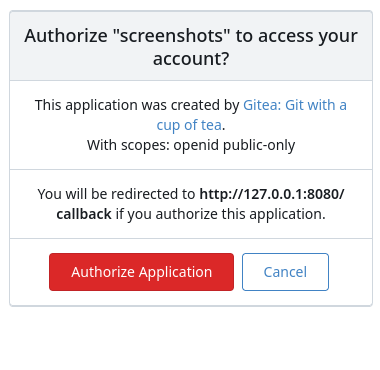
The initial case I wanted to address was to have Gitea act as an OAuth2
Identity Provider. To achieve that, with this PR, I would only add
`openid public-only` to provide access token to the third party to
authenticate the Gitea's user but no further access to the API and users
resources.
Another example: if a third party wanted to interact solely with Issues,
it would need to add `read:user` (for authorization) and
`read:issue`/`write:issue` to manage Issues.
My approach is based on my understanding of how scopes can be utilized,
supported by examples like [Sample Use Cases: Scopes and
Claims](https://auth0.com/docs/get-started/apis/scopes/sample-use-cases-scopes-and-claims)
on auth0.com.
I renamed `CheckOAuthAccessToken` to `GetOAuthAccessTokenScopeAndUserID`
so now it returns AccessTokenScope and user's ID. In the case of
additional scopes in `userIDFromToken` the default `all` would be
reduced to whatever was asked via those scopes. The main difference is
the opportunity to reduce the permissions from `all`, as is currently
the case, to what is provided by the additional scopes described above.
Screenshots:



---------
Co-authored-by: wxiaoguang <wxiaoguang@gmail.com>
1. move "internal-lfs" route mock to "common-lfs"
2. fine tune tests
3. fix "realm" strings, according to RFC:
https://datatracker.ietf.org/doc/html/rfc2617:
    * realm       = "realm" "=" realm-value
    * realm-value = quoted-string
4. clarify some names of the middlewares, rename `ignXxx` to `optXxx` to
match `reqXxx`, and rename ambiguous `requireSignIn` to `reqGitSignIn`
 Giteabot